Picture the security lead of a twelve-hundred-person company. Same obligations as the enterprise, same questions from the underwriter at renewal, a fraction of the budget, and no program office to hand any of it to. That seat is the one this piece is about, and there are far more people sitting in it than in the corner offices the category markets to.
Add up what the last five weeks established. Enterprise AI security platforms of the Palo Alto and Cisco class are excellent — and list pricing for that tier runs $80K+ per year before the platform engineers who operate it. The Big 4 advisory model delivers genuinely customized work at $40K–$150K per engagement on a 6–12 week cycle — a snapshot, re-purchased when the picture moves. GRC automation starts around $10K per year and a sales call, with the median contract roughly double that. Outside counsel will draft an acceptable-use policy for $5K–$25K — once, as of the month it was written. None of these numbers is an accusation. They are what serious enterprise tooling and serious human expertise cost. The trap is that the price of entry starts approximately where a mid-market security budget ends.
The other jaw of the trap
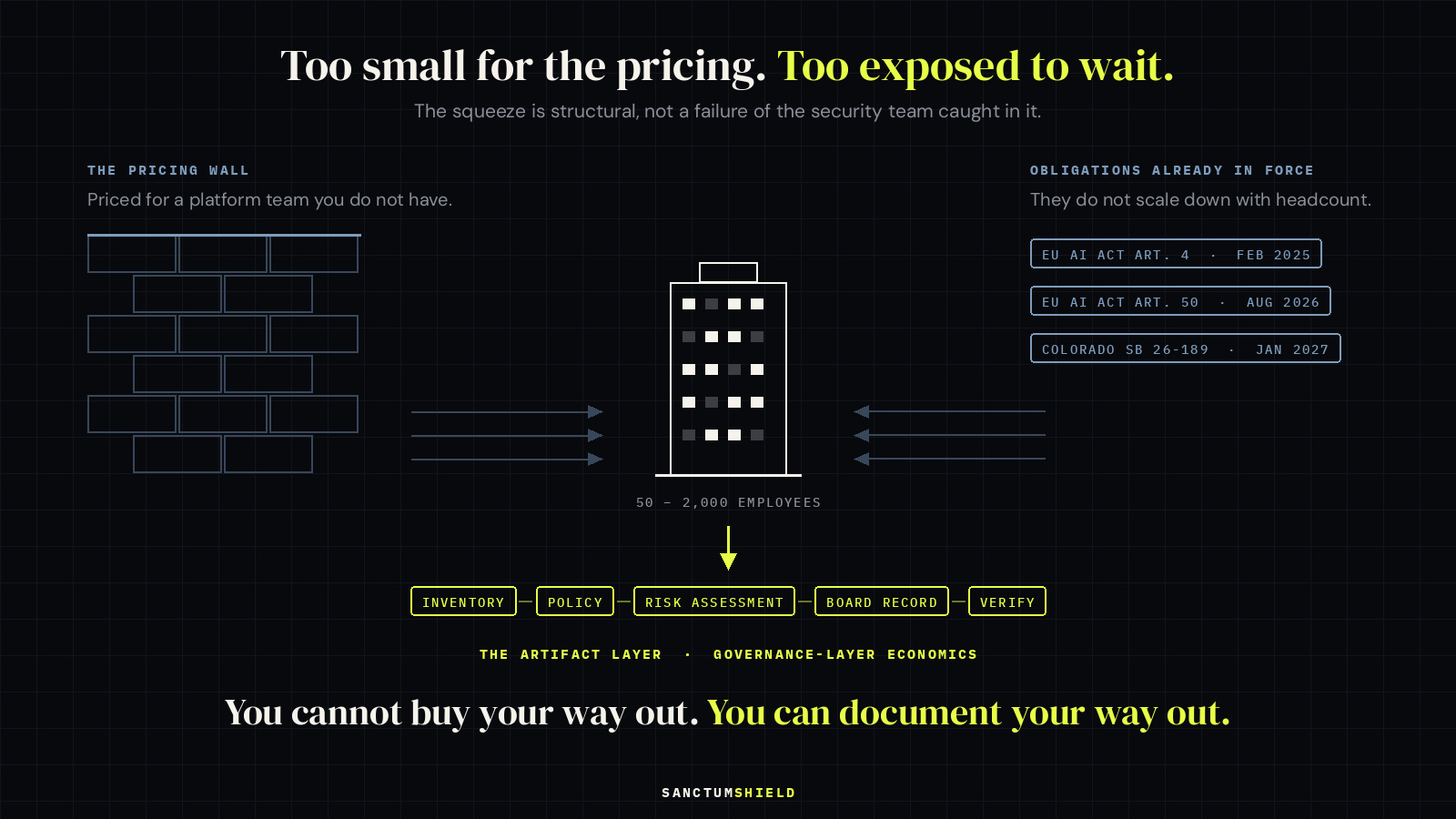
If the obligations scaled down with headcount, the wall would be an inconvenience. They do not. EU AI Act Article 4 AI literacy has applied to providers and deployers of AI systems since February 2, 2025, regardless of size. Article 50 transparency obligations arrived August 2, 2026. Colorado SB 26-189 takes effect January 1, 2027. Cyber-insurance underwriters are asking AI-governance questions on 2026 renewals right now, and a board’s oversight duty does not carve out companies under 2,000 employees. Meanwhile the surface itself moves at AI velocity: embedded features switch on inside SaaS you already pay for, employees adopt tools that did not exist last quarter, and agents get wired to company data over a weekend. A 6–12 week procurement-and-deployment cycle is structurally slower than the thing it is trying to govern.
So the mid-market CISO is squeezed from both sides: too small for the pricing that assumes a platform team, too exposed to wait for the budget that would buy one. The most common response — defer the whole question to next year’s planning cycle — is itself a decision, and it is the one decision that is indefensible in hindsight, because the obligations already in force do not pause for your fiscal calendar.
The exit is a different category, not a discount
The way out of the trap is not a cheaper version of the enterprise platform — a runtime deployment at one-tenth the price would be one-tenth the platform, still needing the team you do not have. The exit is noticing that what the regulator, the underwriter, and the board actually ask a mid-market organization for is not a platform at all. It is the documented artifact chain: an observed AI inventory, a regulation-anchored acceptable-use policy, a risk assessment with named owners, a board record — kept current, and verifiable by an outsider. That is a governance-layer job with governance-layer economics: no agents to deploy, no integrations to build, no platform engineers to hire. It is the job SanctumShield was purpose-built to do at a price a mid-market budget approves without a committee — and it is also simply where every program has to start, because the enterprise platforms themselves need the inventory and the policy as their map.
You cannot buy your way out of the trap at enterprise prices. You can document your way out at mid-market ones.
Pricing figures reflect publicly listed and publicly reported ranges discussed in the earlier Phase 3 pieces and on /vs-vanta; ranges drift — confirm current pricing with each vendor. The full category map lives at /compare.