Every security leader I talk to has already bought good tools. The question underneath most evaluations is not what to buy next. It is which of the things you already own is quietly being asked to do a job it was never built for.
A security leader with Wiz in the stack has a genuinely strong cloud-security program. So when the board asks about AI and someone answers “we run Wiz,” it feels like a complete answer. It’s a good tool answering a real question — just not the whole question. Let’s separate the two.
What Wiz does — and does well
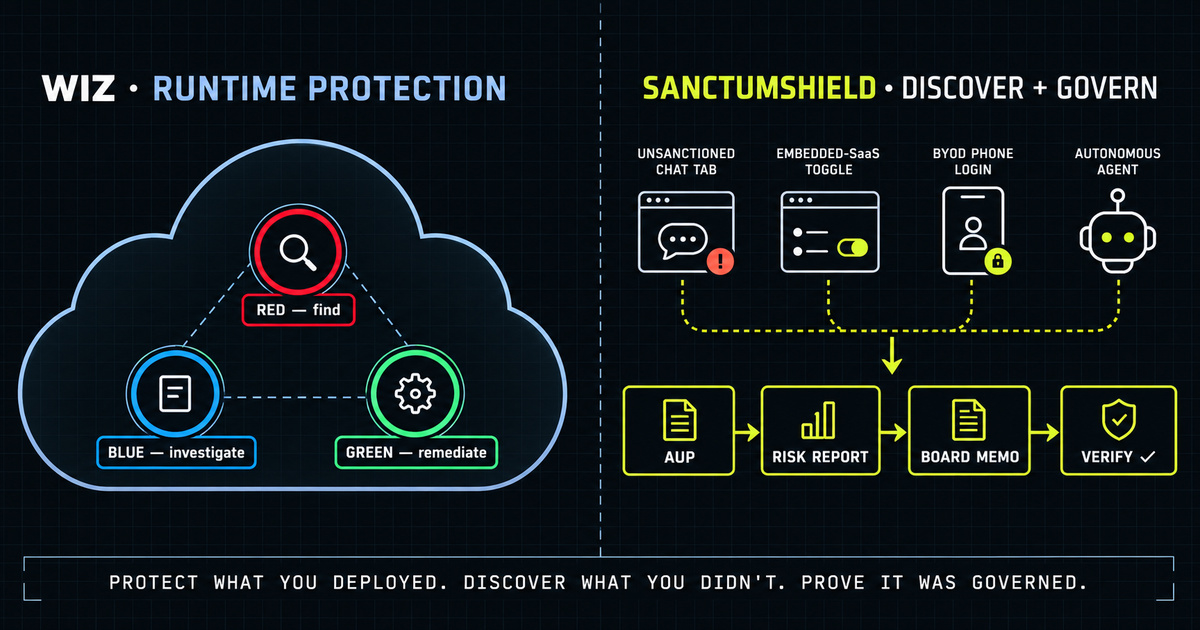
Wiz is the CNAPP category leader, with strong fundamentals across CSPM, CWPP, DSPM, CIEM, Code, and Defend. At Cloud Next ’26 it launched the Red / Blue / Green agent triad — on top of an AI-SPM capability Wiz had already shipped — as a runtime protection layer for the AI agents an organization deploys into its cloud. The division of labor is clean: the Red agent finds where a deployed agent can be exploited, Blue investigates what happened to it, and Green remediates. If your risk is a production AI agent with a misconfiguration or an active exploitation path, this is excellent, and you should want it.
Notice the common word in every one of those jobs: deployed. Wiz secures the agents you built and shipped into infrastructure it can see. That is exactly what a CNAPP should do. It is also exactly where “covered for shadow AI” starts to diverge.
What “covered for shadow AI” actually asks
Shadow AI is, by definition, the AI you didn’t deploy and mostly don’t know about. It lives across four layers: the unsanctioned ChatGPT or Claude tab an employee pastes customer data into; the embedded AI feature that switched on inside a SaaS tool you already pay for; the personal-account BYOD login that never touched your SSO; and the autonomous agent acting on company data outside your cloud. A runtime protection layer scoped to deployed agents in your cloud is not built to see most of that surface — and Wiz doesn’t claim it is. These are different jobs, not a coverage gap Wiz is failing at.
So the first half of the honest answer: for runtime protection of the agents you deploy, Wiz covers you well. For discovering the shadow AI you didn’t deploy, that is a different layer of the problem.
The half no runtime tool produces: the governance artifact
Here is the part that surprises people. Even for the agents Wiz does protect, it produces runtime findings, telemetry, and remediation records — operational evidence, which is real and valuable. What it does not produce is the artifact the board, the SOC 2 auditor, and the cyber-insurance underwriter actually ask for: a regulation-anchored AI Acceptable Use Policy, a documented risk assessment, an Executive Risk Report, a board memo, and a verification URL a third party can independently confirm.
That is the same layer distinction we draw everywhere: a tool that generates evidence is not the same as the governance program that maps the evidence to an owner, a control, a regulatory clause, and a review cadence. Telemetry is not the AUP. A remediation log is not the board memo. Both matter; they are not interchangeable.
So — are you covered?
For runtime protection of deployed AI agents: yes, and well. For discovering shadow AI across all four layers, and for producing the regulation-anchored governance artifact your board and underwriter consume: that is a different layer, and it’s the one Wiz was never priced or scoped to serve for a 50–2,000-employee organization. This isn’t Wiz versus SanctumShield. A serious 2026 program uses both — Wiz to protect what you deployed, SanctumShield to discover what you didn’t and to prove it was governed.
Red finds it. Blue investigates it. Green fixes it. SanctumShield proves it was governed.
Wiz product facts here (CNAPP scope, the Red / Blue / Green agent triad launched at Cloud Next ’26 on Wiz’s existing AI-SPM capability, and its runtime-protection positioning) reflect Wiz’s own public descriptions. The full side-by-side — role by role — lives at /vs-wiz.