1. The evidence gap
Organizations adopted AI coding agents — Claude Code, OpenAI Codex, Cursor, and their peers — faster than they adopted any way to prove how those agents behaved. An agent that can read a repository, run commands, and touch company data is a system acting on the organization’s behalf. Ask most teams to produce a record of what their coding agent did last Tuesday, to which data, under whose authorization, and you get a shrug. That shrug is the evidence gap.
The regulatory calendar is closing that gap whether the market is ready or not. EU AI Act Article 50 — transparency for AI interactions and synthetic content — is in force as of August 2, 2026. The high-risk regime, with its record-keeping and logging obligations, arrives on the two-tier schedule set by the 2026 Digital Omnibus: December 2, 2027 for standalone Annex III systems and August 2, 2028 for high-risk AI embedded in regulated products (Annex I). Colorado’s SB 26-189 lands January 1, 2027 with three-year recordkeeping. None of these ask whether you bought a tool. They ask what you can show.
An agent guardrail is the runtime control that starts producing that record: software in the agent’s execution path that scans, inspects, blocks, or logs its actions against a rule set as they happen, emitting findings, block decisions, human-approval records, and durable exports. That is real, and it is more than a checkbox. But raw telemetry is not yet an answer — which is the whole point of this piece.
2. What runtime guardrails produce — from an actual trial
A guardrail produces findings, block decisions, human-approval records, and durable exports (SQLite, JSONL, OTLP, SIEM). To see exactly what that looks like — and where it stops — we ran one. In a throwaway sandbox, in observe mode (watch and log, never block), we put Cisco DefenseClaw 0.8.10 beside a coding-agent workflow. Two things came out of it, and both are the point.
The evidence is real but context-blind. Day one produced 524 static findings and a baseline CRITICAL alert on a recursive force-delete of the root path. Except the command was echo "rm -rf /" — text printed, nothing deleted. The rule matched the literal string and even flagged our own comment saying so. Every time we merely wrote a dangerous pattern into a memo or a finding title, it re-fired. That is what a high-recall, context-blind layer is: it scores the worst-case potential of a pattern, not intent or execution. The severity total is not risk until a human triages it.
And the tool can become the incident. The observe-mode install silently drifted to fail-closed across four layers and began blocking every tool call in a separate production session — a visibility tool turned into an availability dependency on every action — while its own off-switches hung and its watchdog resisted removal. Two precision points: the guardrail caused that outage (it did not surface a pre-existing problem), and fail-closed was policy executing correctly in the wrong context, not a malfunction. We reported the fail-closed drift and the deadlocking remediation path to Cisco via GitHub’s private vulnerability reporting on August 3, 2026 (advisory GHSA-94gw-wrrg-5594, in triage); response pending. The full account is in We Deployed a Guardrail to Prove Observability Isn’t Governance.
The exports are genuine, durable, exportable records — necessary evidence. They are also raw signal that needs human triage and can, as we saw, fail in ways that themselves demand oversight. They are an input to governance, not governance.
3. The crosswalk (the citable asset)
Here is the durable mapping: the evidence a runtime guardrail produces, the Persuasion-Exposure Validation (PEV) control it can evidence (by identifier and public definition only), and the EU AI Act obligation that evidence supports. The finding types below are drawn from the trial; the honest-gaps row is the headline.
| Guardrail finding type | PEV control evidenced | Enforcement signal satisfied | EU AI Act obligation evidenced |
|---|---|---|---|
| Destructive-command detection | PEV-003 (logging) | Durable, timestamped, operator-attributed record of a consequential agent action | Art. 12 record-keeping (+ Annex III in a high-risk workflow) |
| Exec / process-spawn | PEV-003 (logging) | Durable record of a code-execution event with tool + version + operator | Art. 12 logging; supports Art. 15 cybersecurity monitoring |
| Secret / credential-file access | PEV-003 (logging) | Durable record of sensitive-data access by the agent | Art. 12 logging; supports Art. 15 |
| Cognitive-file / steering-config tampering | PEV-003 (logging) | Durable record that agent-steering or oversight config was altered | Art. 12 logging; relevant to Art. 14 oversight-config integrity |
| GAP — no guardrail finding exists | PEV-001, PEV-002, PEV-004, PEV-005 | Whether a human validated an AI output via adversarial second-model review / disconfirmation, avoided prohibited reliance, completed oversight training, and applied high-risk-workflow controls — none observable by a command pattern-matcher | Art. 14 human oversight; Art. 50 transparency; Art. 17 quality-management — must be evidenced by the governance program |
Two honest caveats. Every mapped row lands on the same control — PEV-003, logging — because what these findings share is the production of a durable record; the guardrail evidences the logging obligation and little else on its own. And even that is incomplete: PEV-003 asks the record to capture the validation method applied and presumes the record is triaged, which a context-blind matcher does not do. The GAP row is the whole thesis: the controls that actually constitute oversight — validating AI outputs, resisting prohibited reliance, training reviewers, gating high-risk workflows — produce no guardrail finding at all. A runtime tool cannot evidence them; a governance program must.
4. What a guardrail does not give you
The clearest statement of a guardrail’s limits usually comes from the guardrail vendors themselves. Cisco’s own scope language for DefenseClaw (as of version 0.8.10, July 2026) is blunt: a guardrail does not prove risk-free operation, and it must be used alongside human review, least-privilege configuration, and ongoing monitoring. Read that carefully — it is the SanctumShield thesis, stated by the tool’s maker. The control generates evidence; it does not certify the outcome.
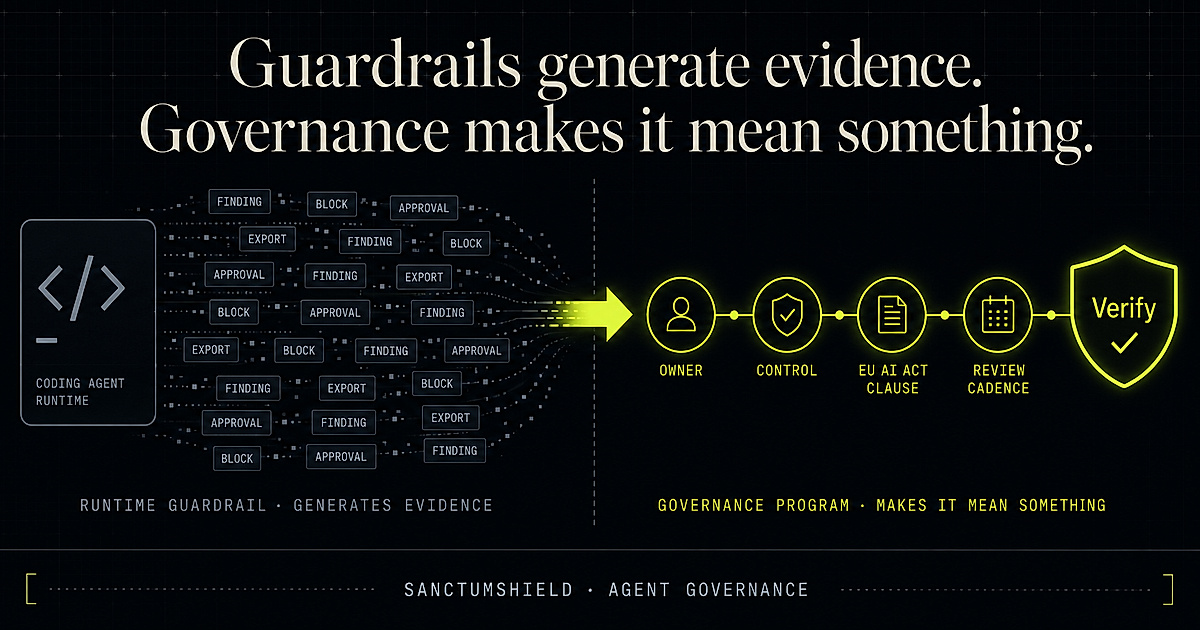
So the guardrail hands you a stream of findings. What it does not hand you is the thing a regulator, auditor, or underwriter actually asks for:
- An owner. A finding nobody is accountable for is telemetry, not a control.
- A control mapping. A block decision that maps to no policy clause proves an event happened, not that a safeguard exists.
- A regulatory citation. A log that cites no obligation answers no questionnaire.
- A review cadence. Evidence nobody reviews on a schedule is a data-retention cost, not due diligence.
That is the layer separation, and it is not a criticism of the tools. Guardrails, SIEMs, and runtime detection are genuinely needed; an organization running coding agents without them is exposed. But needed is not the same as governed. Guardrails generate evidence. A governance program is what makes the evidence mean something — the chain from a raw finding to a named owner, a mapped control, a cited clause, and a dated review. Buy the tool and skip the chain and you have governance theater with better logging.
5. Where this goes
The durable asset is not the tool review — tools version and rot. It is the mapping: from the evidence a runtime guardrail produces, to the validation control it satisfies, to the regulatory obligation it helps you evidence. That crosswalk survives any single guardrail’s disappearance, and it is what turns a pile of agent logs into a governance artifact.
See the research and the controls behind SanctumShield’s approach at /under-the-hood, and the rendered artifact chain — AUP, Executive Risk Report, Board Memo, with independently verifiable URLs — at /sample-outputs.
Tool-specific claims are pinned to Cisco DefenseClaw version 0.8.10 (July 2026) and are reviewed quarterly for staleness; DefenseClaw is cited as one example of an agent-guardrail evidence source, and is never a runtime dependency of SanctumShield. Regulatory dates trace to primary sources — the full citation chain lives in the SanctumShield glossary and on /why-now, refreshed monthly.